Decisions Without Data: The Private Event Reporting Gap
When reporting is manual, slow, and incomplete, private event programs struggle to succeed. This post covers the reporting challenges that enterprise restaurant software should solve, and how things can change when the right data and insights gets in front of the right people.
Quick summary
Running private events across multiple venues means making critical decisions about programs, pricing, and performance. But the data needed to make those decisions well is often fragmented across spreadsheets, inboxes, and slow-moving reports.
Even traditional enterprise restaurant event software tends to focus on processing transactions rather than surfacing the insights that drive program-level improvement.
That means problems go unnoticed, amazing initiatives at one location don’t always find their way to others, and revenue opportunities can slip through the cracks.
-
Private event performance data is often spread across tools, making it difficult to get a single view across locations.
-
Reporting tends to be manual, slow, and often outdated before it reaches revenue and operational leaders.
-
Many event management tools treat reporting and insights as a paid extra, rather than a core capability.
-
Without visibility into conversions and response times, it’s hard for teams to tell what’s working and where revenue is being left on the table.
-
Guest inquiry language can reveal what to double down on and what to improve, but most teams don’t have the tools to surface it.
-
When performance data is comparable across locations, best practices can flow naturally between event teams.
-
Without a centralized view, issues at individual venues can go unnoticed longer than they should.
For hospitality groups and top restaurants, the shift from treating private events as one-off transactions to running them as a structured program is what unlocks consistent and growing revenue.
It all starts with visibility.
Book a demo or join the waitlist to get early access to free trials to see how Paloma gives hospitality revenue, operations, and venue teams the data they need to run stronger private events programs.
Restaurant group leaders can’t fix what they can’t see
For most hospitality groups, private event reporting looks something like this:
- Spreadsheets are updated
- Inboxes are searched
- Calendars are consulted
Then a report is assembled with information that’s often out of date by the time it reaches leadership. Even when the process works, it works slowly. And it rarely gives a complete picture.
And it almost never gives a complete or accurate picture.
The result is that revenue and operations leaders are left making portfolio-wide decisions based on incomplete information:
- Which spaces are converting the most inquiries?
- What is causing leads to fall off?
- Are key metrics consistent across locations?
Without a centralized view, these types of questions go unanswered, and the gap between top-performing and underperforming locations stays invisible.
This is the gap that enterprise restaurant event software should close, but typically don’t.
Paloma’s Dashboard changes this by bringing engagement, performance, and revenue data into a single view that can be viewed for one location or aggregated across many.
Instead of waiting for a monthly report, teams can instantly view completed and partial inquiries, average completion times, and engagement trends in real time.
Filter by venue, adjust the date range, and the picture sharpens immediately. No assembly required.
Revenue, ops, and engagement metrics in one place
Revenue and operations leaders working at enterprise restaurant companies need to know, at a glance, how their private event program is actually running:
- Are inquiries converting into bookings?
- How fast are venue teams confirming?
- Which locations are generating the most revenue?
The Stats section in the Paloma Dashboard shows essential metrics across three domains, each filterable by specific date ranges.
Guest engagement
The Usage page shows how guests are interacting with your private event booking experience, and where drop-offs are happening:
- Percent of completed and partial inquiries
- Average time to inquiry completion
- Percent of inquiries by type of event
This is how hospitality leadership and venue teams can spot guest friction early.
A high number of partial inquiries, for example, may signal that the information in the Booking Widget for that location need some attention.
Operational performance
The Operations page tracks how effectively event teams are converting interest into confirmed bookings:
- Booking trends and bottlenecks
- Overall conversion rates and lost inquiry reasons
- Response times relative to targets
- Email volume per inquiry, broken down by guests and venue teams
With Paloma, pre-qualified inquiries arrive ready to close. How fast they are approved is often all that separates new revenue from lost business
There’s also a venue-level comparison of inquiry volume, conversion rates, and average response times across every location
Revenue intelligence
The Revenue view gives leadership teams a complete financial picture across the entire portfolio:
- Total revenue, average revenue per event
- Avg. revenue per guest
- Revenue per venue and day of week
- Revenue per guest and event type
- Top earning events
- Monthly trend vs last year for year-over-year comparison
This is how private events stop being a black box and start becoming a measurable, improvable program.
What guest inquiry data can tell restaurant leaders
The multi-location restaurant world doesn’t run on metrics alone.
One of the most valuable but overlooked data sources in private events is the language that guests use when making inquiries.
- What types of occasions are they booking?
- What group sizes come up most often?
- What amenities do they ask about?
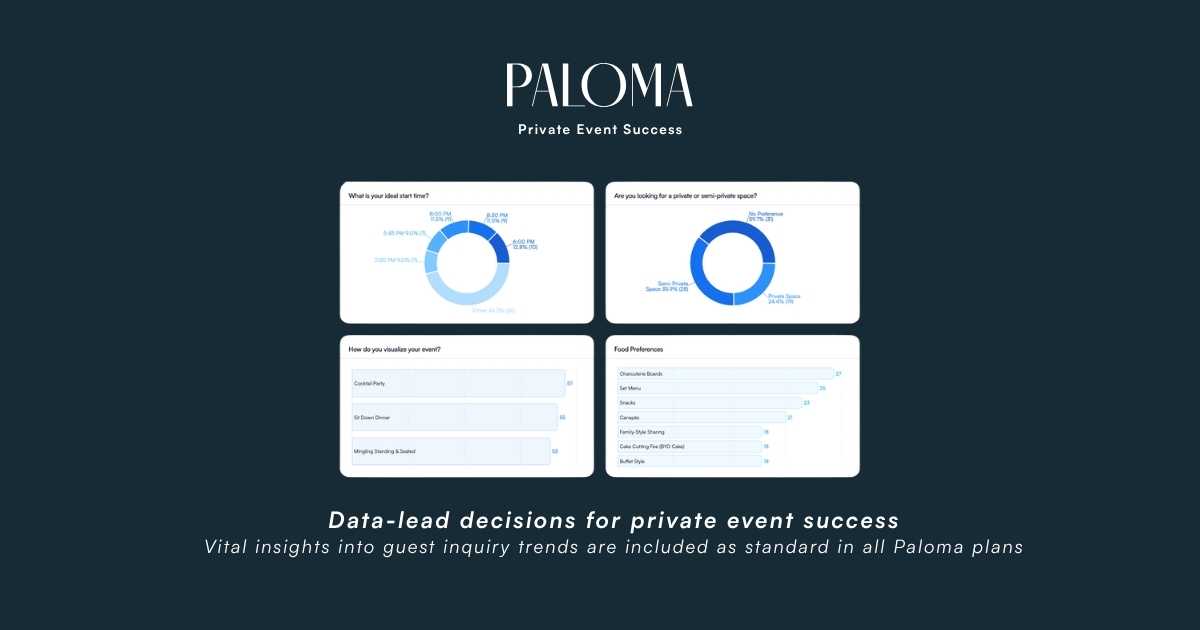
Paloma captures and analyzes this inquiry data automatically.
Over time, patterns emerge that pinpoint exactly where to double down, and where to pull back.
For example, if 45% of inquiries at a location are for company meetups, that venue’s spaces, amenities, and marketing should address that demand.
If another location sees consistent demand for private spaces, but guests rarely ask about semi-private options, the team can make better decisions on the layouts they offer for private events.
These kinds of insights come from Paloma’s structured analysis of what guests are saying when they inquire, including those who complete inquiries, and those who don’t.
The language guests use in private event inquiries can be used to build a precise roadmap for increasing revenue and loyalty from private events.
Cross-portfolio insights
When insights powered by real customer engagements are surfaced, revenue and operations leaders can quickly identify what’s working at one venue, and implement those practices at others.
For example, a location that’s excelling at converting large groups can become a model for other locations.
Instead of each venue figuring things out independently, the entire group becomes more successful.
See data-powered decision making in action
Paloma gives revenue and operations teams at enterprise hospitality groups a clear and up-to-the minute view of private event performance across every location in their portfolio.
For GMs and event teams, the Dashboard brings together the insights needed to improve private event performance and create better guest experiences over time.
Replace manual reports with real-time visibility. Replace guesswork with data. That’s the future of private event success in the hospitality industry.
Book a demo or signup to get early access to a free 15-day trial to see how Paloma can help your team make better decisions with data.