What Your Private Events Page Is Missing (and Costing You)
For most hospitality venues, private events are one of the highest-margin revenue streams on the books. So why is the private events page usually the most neglected corner of the website?
Quick summary
The private events page on hospitality websites is often the first thing a high-intent prospects see.
For restaurant, hotel, brewery, winery, golf course, and other venues, private events can represent up to 50% or more of their monthly revenues, so optimizing these pages is well worth the effort.
Here are the top tips for levelling-up the private event booking experience on websites:
- Give private events their own page, separate from your public calendar
- Use “private events” or “group bookings” in your slug and metadata
- Showcase the spaces with high quality images, and, ideally, a short video
- List real details on capacity, layout, and indoor/outdoor options
- Be upfront about pricing, deposits, and minimum spends
- Link to your menus and clarify any policies with regard to group bookings
- Include at least one testimonial from a past event guest
- Make the next step in the booking process obvious
- Tell prospects how fast you’ll respond to inquiries
In this post we break down why each of these elements matters and how to improve your private events page without creating more work for your team.
What’s up with web pages for private events?

A great private events page filters out the wrong leads and gives the right ones every reason to keep going.
Someone just got engaged. Their first move is opening their browser and searching private event venues. They click through four or five options, scan each page for about thirty seconds, and book a call with the one that made it easiest to say yes.
Was your group bookings page a part of their journey? And if it was, did it do its job?
A private events page is often the hardest-working page on your website. It’s where high-intent, high-value prospects land, decide whether you’re worth contacting, and either move forward or move on.
Many venue pages lose in that moment, not because their spaces aren’t right, but because the page doesn’t give prospective guests what they need to take the next step.
Anatomy of a great private events web page
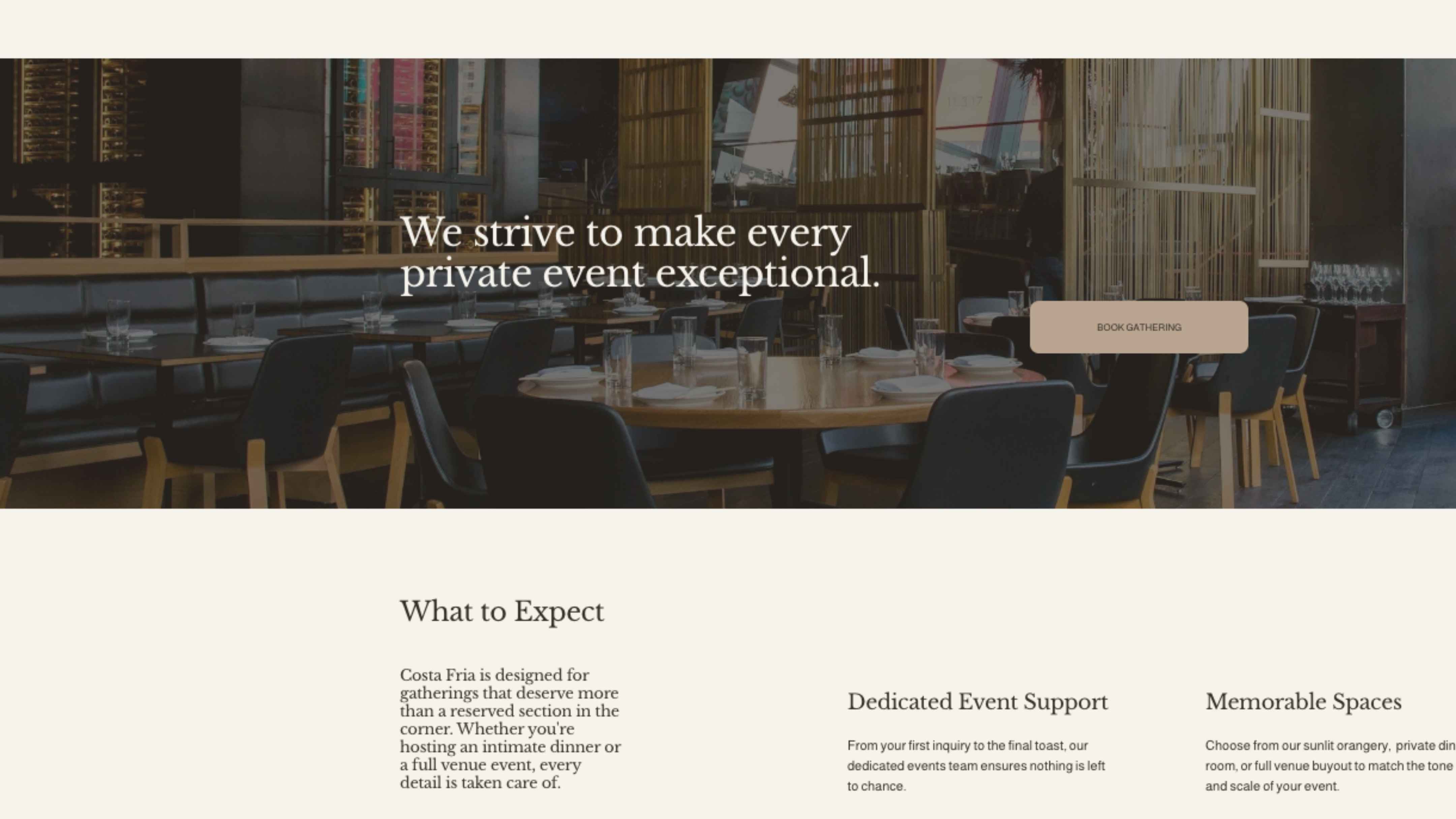
Here’s a quick list of what venues with robust private event programs get right:
Give private events their own page
This sounds obvious. It isn’t. Many venue websites bury private event information inside something else, like a contact page or public events page, where it competes for attention with trivia nights and live music schedules. That’s a different audience with a different intent. Your private events page (or ‘Group Bookings’ page if that framing suits your venue better) deserves its own navigation link, its own URL, and its own focus.
Showcase your spaces
People are booking a physical experience. They need to see it before they’ll commit to a conversation. High quality images of your spaces are non-negotiable. A short video walkthrough is even better. Show the room set up for an event, not just empty. Help them picture their group there.
Provide guests with real details
Capacity numbers for each space, indoor and outdoor options, layout configurations, any restrictions on what’s available for private bookings versus your regular offering. Put the actual information on the page. “Contact us for details” is not information. It’s a barrier. Every unanswered question is a reason to look elsewhere.
Be transparent about pricing
Rental fees, minimum spends, deposits, booking fees. Whatever your model, put it on the page. Prospects who don’t know what to expect won’t inquire. Prospects who inquire without knowing will waste your time when the price comes as a surprise. Pricing transparency filters out the wrong leads and gives the right ones the confidence to move forward.
Link to your menus
Not only link to your menu, but be specific about what’s available for private events. If certain packages are exclusive to group bookings, say so. If there are minimum spends or food and beverage conditions, be upfront. Transparency here does the same job as pricing transparency. It qualifies leads before they even contact you.
Add a testimonial
One real quote from a past event guest does more than three paragraphs of marketing copy. If you have it, use it. If you don’t have it yet, make collecting it a priority after your next successful event.
Make the next step obvious
What do you want someone to do when they reach the bottom of the page? If the answer isn’t immediately clear, you’ve lost them. Whether it’s a form, a booking tool, or a direct contact link, the call to action should be impossible to miss and frictionless to complete. If you’re using a form, keep it short. Name, event type, date, and group size is enough to start a conversation.
Tell guests how fast you’ll respond
This is the tip most venues skip. A prospect who submits an inquiry and hears nothing for 48 hours has already booked somewhere else. Even a simple line like “We’ll get back to you within the hour” sets an expectation and builds confidence that someone is actually on the other end.
Sort your slug and metadata
Your URL should include the words “private events” or “group bookings.” Not /events, not /book, not /hire. Search engines use your slug to understand what the page is about. While you’re at it, ask your webmaster to write a metadata description that references private events and your city. It takes five minutes and helps every search that follows.
Beyond the static page
The tips above will make your private events page significantly better. But most pages still end the same way: a form, an email address, or a phone number. The prospect fills something out, then waits.
A new wave of technology is starting to change the equation by making guests the top priority, starting with the booking experience.
No question, improving your private events page is a great start, but the next big opportunity is to start to attack the shortcomings of those old-fashioned forms, phone numbers, and email addresses.
About Paloma
Paloma is the Event Success Platform for hospitality teams, helping venues increase private event revenue, reduce unproductive admin, and deliver exceptional guest experiences. Your multilingual Digital Concierge pre-qualifies private event inquiries 24/7 across web and social and keeps guests and event teams aligned through a single workflow that leverages your existing email and calendar tools. Booking trends and performance insights support the continuous improvement of private event programs across one or many locations._ Join the waiting list to get early access._